Portrait of Yuwei Xia

Applied Linguistics · Learning Technology

Yuwei Xia

Selected work

  • Word360Reframes vocabulary learning as concept development, the first approach to unite Nation's model of word knowledge with SCOBA and concept-based language teaching, built on a corpus-based form–meaning–use lexical network and AI-mediated instruction
  • Beyond DetectionA sociocultural rethinking of assessment for generative AI: an audit showing that AI-text detection verdicts are not reliable against rewriting, and portfolios that make the writing process and AI use visible
  • MediateTeacher education through practice conferences with AI-simulated English learners, building the judgment of how much help a learner needs
  • Distributed mediation in AI-assisted dynamic assessmentLanguage Learning & Technology, 2026, corresponding author; conceived the study and its framework
  • DirectorTexas State Intensive English Program
  • PhD CandidateCurriculum and Instruction, Penn State
  • Principal InvestigatorSpark Grant, Texas State
  • Research Team MemberCLARITY, Penn State

About

Yuwei Xia is a PhD candidate in Curriculum and Instruction at Pennsylvania State University and Director of the Texas State Intensive English Program at Texas State University. She holds an MA in Applied Linguistics from Teachers College, Columbia University.

Her doctoral research, conducted under the guidance of Dr. Xiaofei Lu and Dr. Matthew Poehner, examines how dynamic assessment and concept-based instruction can advance L2 vocabulary development and, through that process, cultivate learners' capacity for self-regulated, transferable learning. That line of inquiry led her to design Word360, an AI-assisted vocabulary learning system that puts these theoretical principles into practice. Word360 is now live on the web.

Across her projects, generative AI is treated as a mediational tool whose value depends on how learners engage with it. She designed WriteMed, an AI mediator for dynamic assessment of L2 academic writing that guides revision through graduated hints rather than corrections. Extending the same principle to teacher education, she designed Mediate, a practice simulator in which ESL teachers hold conferences with AI-simulated learners and receive a coach report on how each move, from waiting to explicit telling, shaped the learner's response. In Beyond Detection, she argues that writing assessment in the age of generative AI should move from detection toward portfolio-based, process-oriented accountability, a framework she is now testing as Principal Investigator of a Spark Grant pilot in first-year composition at Texas State. She also contributes to CLARITY, a Penn State research program on how engineering students and faculty engage with AI in learning and teaching.

As a program leader, she directs curriculum redesign, CEA accreditation, faculty development, and operations for an intensive English program offered in person and online, drawing on more than a decade of teaching and program leadership in China and the United States.

2,000+

students guided through test preparation programs

100+

multilingual students and educators mentored at Penn State

16

publications, manuscripts, and conference presentations

2015

first year in the classroom, as a secondary English teacher

Research

Four connected strands, each asking how AI can mediate learning.

01

AI-mediated dynamic assessment

Designing AI mediators that offer graduated, progressively explicit support, so that learner responses become evidence of developing ability and assessment and instruction happen in the same cycle.

WriteMedMediate

Publications and projects in this area →

02

Concept-based instruction and L2 vocabulary

Grounded in Vygotskian sociocultural theory, this strand helps learners build scientific concepts of word knowledge across form, meaning, and use, supported by authentic corpus evidence.

DissertationAAAL 2024 – 2026

Publications and projects in this area →

03

Writing assessment beyond AI detection

Moving evaluation from surveillance toward dialogic, process-oriented accountability through portfolios, AI-use process memos, and four dimensions: product, revision, reflection, and transparency.

Beyond DetectionSpark Grant pilot

Publications and projects in this area →

04

AI in disciplinary teaching and learning

Generating empirical evidence on how students and faculty actually use AI, and translating it into guidelines, instructional resources, and responsive tutoring agents.

CLARITY

Publications and projects in this area →

Areas of expertise

Curriculum DevelopmentTeacher TrainingESL & ELA EducationEducational LeadershipSCT in L2 EducationDynamic AssessmentAI-Integrated AssessmentAI in Language LearningProgram Management

Education

Expected May 2027

PhD, Curriculum and Instruction

Pennsylvania State University

Doctoral candidate (ABD). Advisors: Dr. Xiaofei Lu and Dr. Matthew Poehner.

May 2020

MA, Applied Linguistics

Teachers College, Columbia University

Research & Development

AI tools and studies for language learning and writing assessment, grounded in sociocultural theory.

Featured · AI in language learning and assessment

01
Live on the web and iOS2025 – 2026

Word360 · 全景单词 ↗

AI-Assisted Vocabulary Learning System

Reframes vocabulary learning as concept development, the first approach to unite Nation's model of word knowledge with SCOBA and concept-based language teaching, built on a corpus-based form–meaning–use lexical network and AI-mediated instruction.
  • Designed Word360, translating the integration of Nation's model of word knowledge, SCOBA, and concept-based language teaching into a working learning environment.
  • Organized learning around form, meaning, and use as a scientific concept of word knowledge, with schematic orientation guiding learners through each dimension so that they construct understanding rather than memorize definitions.
  • Designed AI mediation into every stage of the learning cycle: learners first articulate what they already know about a word, then receive graduated, targeted support as they use it in sentences of their own.
  • Modeled word knowledge as a form–meaning–use lexical network covering the 10,000 most frequent BNC/COCA word families, with each of its 316,969 word-pair relations typed by dimension and screened before inclusion; most of its synonym and antonym relations are not attested in WordNet or ConceptNet, and each typed relation lets the system state why it recommends the next word.
  • Matched corpus example sentences to each learner's developing vocabulary by placing sentence and learner on a single Zipf frequency scale, estimated from the words the learner studies rather than from a placement test, so that the target word is the only unfamiliar item in the example.
  • Designed the system to capture learning processes over time, supporting research on concept development and on how learners engage with AI mediation.
Word360 in 90 seconds: learning a word across form, meaning, and use, with an AI tutor checking each sentence.
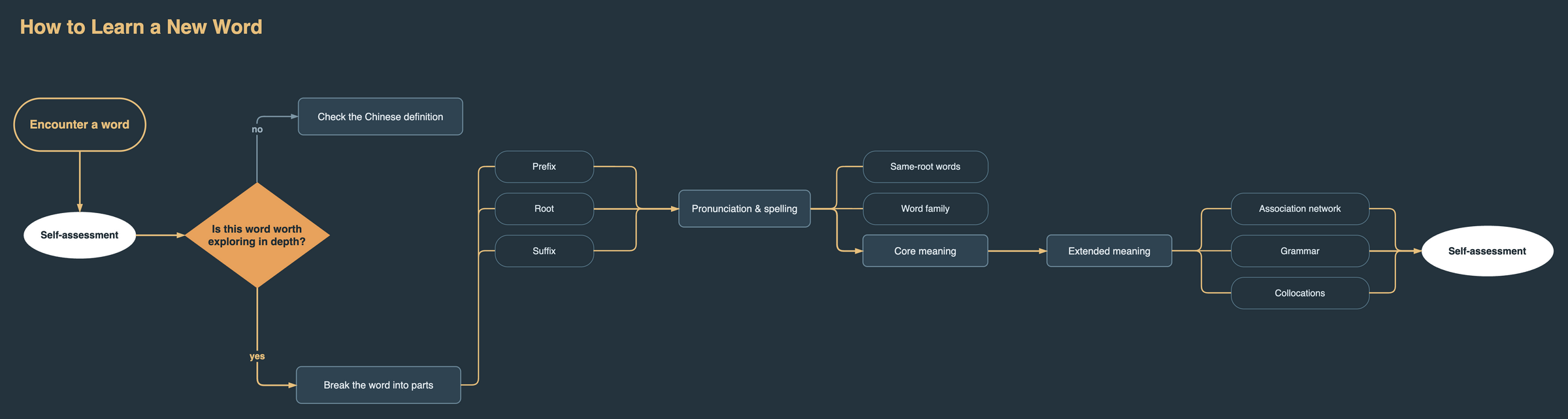
Flowchart of the Word360 vocabulary learning workflow, from encountering a word through word parts, pronunciation, core and extended meaning, to self-assessment
The Word360 learning workflow, from encountering a word to self-assessment across form, meaning, and use.
Concept-based instructionForm–Meaning–UseAI-mediated instructionCorpus-informed learningLexical networkAdaptive learning
Visit word360.org ↗ Download on the App Store ↗ Design and research →
02
Framework and detector study · now in a funded pilot2025 – Present

Beyond Detection

Rethinking Writing Assessment in the Age of Generative AI

A sociocultural rethinking of assessment for generative AI: an audit showing that AI-text detection verdicts are not reliable against rewriting, and portfolios that make the writing process and AI use visible.

  • Critiqued AI-detection-based assessment, arguing that unreliable verdicts lead students to learn to avoid being flagged rather than to learn the knowledge an assignment is meant to build.
  • Reframed generative AI through Vygotskian sociocultural theory and Freirean critique as a mediational tool whose educational value depends on how learners engage with it.
  • Proposed a portfolio-based assessment framework incorporating planning materials, multiple drafts, a structured AI-use process memo, and a final submission.
  • Defined four assessment dimensions to shift evaluation from surveillance toward dialogic, process-oriented accountability: product quality, depth of revision, quality of reflection, and transparency of tool use.
  • Built 15,985 pairs of human-written and AI-generated texts in two domains: 11,030 from pre-2021 arXiv articles in physics, mathematics, computer science, and statistics, and 4,955 from student essays in seven corpora.
  • Trained a recognizer and a rewriter from the same paired data; at thresholds flagging 1% of human writing, each of three detector families judged 81–86% of the rewritten AI texts as human, so for the detectors and corpora tested, detection verdicts are not reliable against such rewriting.
Generative AILearner corporaDetector evaluationAI-use transparencyPortfolio assessmentSociocultural theoryFreirean critique
03
Live on the web2025 – 2026

WriteMed ↗

AI Mediator for Dynamic Assessment of L2 Academic Writing

Brings Vygotskian dynamic assessment into L2 academic writing, so that an AI mediator guides revision through graduated hints and the learner remains the author.

  • Designed WriteMed, an AI-mediated writing environment that applies Vygotskian dynamic assessment to L2 academic writing, so that instruction and assessment take place within the same revision cycle.
  • Focused each revision cycle on a single aspect of the draft (content, organization, or language) to reduce feedback overload and direct learner attention.
  • Operationalized graduated mediation as a sequence of increasingly explicit prompts, from questions about the learner's own wording to targeted examples, treating the level of support a learner needs as evidence of developing ability.
  • Kept the learner as the author: the AI prompts reflection and revision rather than supplying corrections or model sentences.
  • Traced each revision alongside the mediation that preceded it, supporting research on learners' zone of proximal development.
Dynamic assessmentGraduated mediationL2 academic writingSociocultural theory
Visit writingmediation.org ↗ Design and research →
04
Live on the web · In testing2026 – Present

Mediate ↗

AI Practice Simulator for Mediation in ESL Teacher Education

Prepares ESL teachers to mediate rather than correct, through practice conferences with AI-simulated learners and a coach report that traces how each teaching move shaped the learner's response.

  • Designed Mediate, a practice environment for teacher education in which ESL teachers hold timed conferences with simulated English learners, rehearsing a core skill of responsive teaching: judging how much help a learner needs.
  • Operationalized a graduated scale of five teaching moves, from waiting and open questions to examples and explicit telling, modeled on Aljaafreh and Lantolf's regulatory scale and Poehner's typology of mediation in dynamic assessment.
  • Specified fixed rules for how each simulated learner responds to each level of support, so that the same move can draw a genuine answer from one learner and mere compliance from another.
  • Followed each conference with an independent transfer task, two reflection questions, and a coach report that describes what each turn did for the learner and suggests a less explicit alternative, without scores or rankings.
  • Structured scenario packs and learner profiles as editable course materials, with a trainer view for drafting packs from a syllabus and reviewing session records, supporting research on how teachers develop mediation skills.
Teacher educationDynamic assessmentGraduated mediationAI simulationReflective practice
Visit mediate.training ↗

Collaborative research

Research Team Member2026 – Present

CLARITY

Co-attendant Learning Agent for Responsive Intelligent Tutoring

Pennsylvania State University · PIs: Dr. Andrea Gregg, Dr. Tamy Guimarães, Dr. Xiang Yang

Role and contributions
  • Contribute to a multi-PI research program generating empirical evidence on how undergraduate engineering students and faculty engage with AI in learning and teaching.
  • Support mixed methods data collection and analysis, including literature reviews and synthesis of findings across qualitative and quantitative sources.
  • Contribute to AI usage guidelines and instructional resources supporting engineering faculty integrating AI into their courses.
  • Support iterative design of a responsive intelligent tutoring agent for concept-intensive engineering courses, alongside undergraduate capstone course support and student mentoring.
Intelligent tutoringEngineering educationMixed methodsAI guidelines
Team Member2020 – Present

Language Assessment Lab, Indiana University

Directed by Prof. Sun-Young Shin

A research lab devoted to theory, research, and practice in second and foreign language assessment, with interests in L2 vocabulary assessment, integrated assessment, L2 pragmatics, and standard setting. Contribute ideas and perspectives on language assessment through ongoing discussions with lab faculty and members.

Visit lab site ↗
Language assessmentL2 vocabulary assessment

Grants & funding

Spark Grant, Texas State University · Principal Investigator · 2026 – 2027. From AI Detection to Portfolio Assessment: A One-Semester Pilot Study in First-Year Writing.

Experience

Program leadership, university teaching, and classroom practice since 2015.

Jan 2024 – PresentLeadership

Director

Texas State Intensive English Program, Texas State University

  • Provide strategic and operational leadership for the TSIE program, serving international and domestic learners of varied ages and backgrounds across in-person and online modalities.
  • Direct the redesign and implementation of a comprehensive, student-centered ESL curriculum.
  • Oversee accreditation and compliance for CEA standards.
Show 6 more and key achievementsShow less
  • Recruit, mentor, and supervise ESL faculty and staff, including coaching novice instructors on lesson design, classroom management, and assessment practices, a responsibility parallel to supervising pre-service teacher cohorts.
  • Manage budgets and streamline operations to align with strategic goals.
  • Collaborate with international student services to enhance engagement and retention.
  • Consult on an ongoing basis with chairs and program leaders across academic departments on strengthening students' academic English and integrating technology into writing courses.
  • Lead workshops and individual consultations for faculty across departments, including AI literacy sessions for faculty and graduate students on the responsible and effective use of AI in research, and help instructors identify where students struggle and develop more effective instructional solutions.
  • Develop effective assessment systems and student support strategies.

Key achievements

  • Led a full curriculum overhaul, improving student satisfaction and engagement.
  • Secured and maintained CEA accreditation.
  • Elevated instructional quality through professional development.
Sep 2022 – May 2024Teaching

Adjunct Lecturer

Applied Linguistics, Penn State University

  • Designed and taught the undergraduate course Composition for American Cultural Contexts and the graduate course Language Testing and Assessment, mentoring 100+ multilingual undergraduates and pre-service/in-service language educators with a 95% student satisfaction rate.
  • Created syllabi, lesson plans, and assignments for both courses.
  • Conducted workshops, individual conferences, and office hours using student-centered, inclusive practices responsive to multilingual learners' linguistic and cultural backgrounds.
Show 1 more and key achievementsShow less
  • Developed digital resources and assessment strategies for enhanced performance tracking.

Key achievements

  • Mentored over 100 students with a 95% satisfaction rate.
  • Introduced CEFR-aligned rubrics improving project quality by 20%.
  • Pioneered inclusive instructional practices for multilingual learners.
  • Created digital learning modules for accessibility and engagement.
Aug 2016 – Aug 2023Leadership

Director of Academic Test Center

Illumination Education Co., Ltd.

  • Directed test prep programs (SAT, ACT, GRE, GMAT, HSK).
  • Delivered bilingual instruction and managed academic programming.
  • Recruited, trained, and mentored instructors through observation, feedback cycles, and co-planning; led the program's transition to online learning during COVID-19.
Show 1 more and key achievementsShow less
  • Designed curriculum and assessment tools tailored to exam objectives.

Key achievements

  • Guided 2,000+ students to improved test scores and global university admissions.
  • Developed scalable curriculum models and bilingual instructional frameworks.
  • Achieved 90% satisfaction rate and 25% test score improvement.

Publications & Presentations

Journal articles, manuscripts under review, and conference papers.

2026

Distributed mediation in AI-assisted dynamic assessment: Learner-AI interaction and revision across EFL writing continuation tasks

Xu, Q., Xia, Y., Lu, X., & Zeng, Z. Language Learning & Technology, 30(1)

Accepted for publication; corresponding author. Conceived the study and proposed both the experimental design and the distributed mediation framework. The article reconceptualizes mediation in AI-assisted dynamic assessment as distributed across teacher-designed prompts, AI-generated feedback, and teacher mediation, with implications for critical AI literacy.

In review

Beyond the Tool: A Sociocultural Perspective on Structured Mediation and the Development of Learner Agency in AI-Assisted L2 Writing

Yuwei Xia, Qi Xu, Ziyan Zeng

Examined the role of structured mediation in shaping learner agency within AI-supported L2 writing from a sociocultural perspective.

Under review
Ongoing

Beyond detection: Auditing AI-text detectors with a recognizer and a rewriter trained from the same paired data

Xia, Y.

Tests whether AI-text detection verdicts are reliable enough to serve assessment, using 15,985 human–AI text pairs from academic articles and student essays.

Ongoing research
Ongoing

Modeling what it means to know a word: A form–meaning–use lexical network

Xia, Y.

Makes Nation's form, meaning, and use the type system of a lexical network of 316,969 screened word pairs, so that word recommendations can state their reason.

Ongoing research
Ongoing

Learner-adaptive example selection: Matching corpus examples to the learner's lexical frontier

Xia, Y.

Places learner and example sentence on one Zipf frequency scale, so that each learner meets corpus examples they can read.

Ongoing research
2027

From memorizing to knowing: A concept-based tool for developing vocabulary depth and learner agency

Xia, Y. Accepted for presentation at the American Association for Applied Linguistics (AAAL) Conference, Atlanta, 2027 · Individual Paper

Presents a concept-based vocabulary tool that turns Nation's framework of word knowledge into a learner-facing concept, tracing seven learners' development toward systematic, self-regulated vocabulary learning.

Conference presentation
2027

Perezhivanie in L2 vocabulary learning: The emotion–cognition unity of coming to know a word

Qin, Y., & Xia, Y. Accepted for presentation at the American Association for Applied Linguistics (AAAL) Conference, Atlanta, 2027 · Individual Paper

Examines how emotion and cognition operate as a unity in mediated vocabulary learning, using perezhivanie as a unit of analysis in a microgenetic study of learners in a concept-based instruction intervention.

Conference presentation
2026

Structured Mediation and Learner Agency in AI-Supported L2 Writing: A Sociocultural Perspective on Generative AI Feedback

Xia, Y., & Xu, Q. American Association for Applied Linguistics (AAAL) Conference, Chicago, 2026 · Individual Paper

Conference presentation
2026

Concept-Based Vocabulary Notebooks: Developing Scientific Concepts of Vocabulary Knowledge among Chinese EFL Learners

Xia, Y. American Association for Applied Linguistics (AAAL) Conference, Chicago, 2026 · Individual Paper

Investigated how concept-based vocabulary notebooks support the development of scientific concepts of vocabulary knowledge among Chinese EFL learners.

Conference presentation
2025

Dynamic Assessment and Concept-Based Instruction of Vocabulary Knowledge

Xia, Y. AAAL Conference, 2025 · Poster Presentation

Explored the integration of dynamic assessment and concept-based instruction for enhancing vocabulary knowledge.

Conference presentation
2025

Effects of AI-assisted dynamic assessment on lexical richness and learner engagement in EFL writing

Xia, Y. AAAL Conference, Denver, March 22, 2025 · Individual Paper

Explored the impact of AI-assisted dynamic assessment on lexical richness and engagement in EFL writing.

Conference presentation
2025

Dynamic Assessment of Vocabulary: A Systematic Literature Review

Xia, Y. AAAL Conference, Denver, March 22, 2025 · Individual Paper

Discussed the application of Vygotsky’s theories in dynamic vocabulary assessment.

Conference presentation
2024

Dynamic Assessment of Vocabulary: A Systematic Literature Review

Xia, Y., Luo, Y., & Lu, X. Language Teaching Research Quarterly, 46, 297–324

First and corresponding author.

2024

Mediating the Use of Digital Reference Tools for the Development of Vocabulary Knowledge

Xia, Y., & Kim, M. CALICO Conference, Pittsburgh, 2024 · Individual Paper

Focused on the mediation of digital reference tools to enhance vocabulary knowledge development in language learners.

Conference presentation
2024

Dynamic Assessment of Chinese English Language Learners’ Vocabulary Knowledge

Xia, Y. AAAL Conference, Houston, 2024 · Poster Presentation

Focused on using dynamic assessment methods to evaluate the vocabulary knowledge of Chinese English language learners.

Conference presentation

Teaching

Graduate, undergraduate, secondary, and teacher education settings since 2015.

University teaching

2022 – 2024

Language Testing and Assessment

Graduate course · Applied Linguistics, Penn State University

Designed and taught the graduate assessment course for pre-service and in-service language educators, creating the syllabus, lesson plans, and assignments.

2022 – 2024

Composition for American Cultural Contexts

Undergraduate course · Applied Linguistics, Penn State University

Taught first-year composition for multilingual undergraduates through workshops, individual writing conferences, and CEFR-aligned rubrics. Across both courses, mentored 100+ students with a 95% satisfaction rate.

2022 – 2023

Online reading course development

Penn State World Campus

Developed interactive, accessible reading course content and aligned learning objectives with assessments.

Teacher development

2024 – Present

ESL faculty development

Texas State Intensive English Program

Coach novice instructors on lesson design, classroom management, and assessment practices, and lead professional development for program faculty.

2016 – 2023

Instructor training

Illumination Education

Recruited, trained, and mentored instructors through observation, feedback cycles, and co-planning, and led the program's transition to online teaching during COVID-19.

Language instruction

2016 – 2023

Test preparation and bilingual instruction

Illumination Education · SAT, ACT, GRE, GMAT, HSK

Designed exam-aligned curriculum and assessment tools and taught bilingually, guiding 2,000+ students toward higher scores and university admission.

2019

Chinese as a foreign language

CIFLTE Program, Columbia University

Delivered individualized instruction built on task-based language teaching that integrates form, meaning, and use.

2015 – 2018

Secondary English, Grades 10–12

High School Affiliated to Southwest University, Chongqing

Taught reading, writing, listening, and speaking across multiple sections, and designed and taught an interdisciplinary Social Science elective as sole instructor of record.

Approach

Task-based language teachingAI-assisted instructionCEFR-aligned assessmentInclusive practice for multilingual learnersBilingual instruction (English and Chinese)Online and accessible course design

Service & Community

Mentoring, student government, and professional communities.

Aug 2022 – May 2023

Graduate Assistant

Penn State World Campus

  • Developed interactive, accessible reading course content and aligned learning objectives with assessments.
  • Guided students in academic and personal goal setting, supporting achievement planning.

Jan 2019 – May 2019

Chinese Teacher

CIFLTE Program, Columbia University

  • Delivered individualized Chinese language instruction based on learner goals.
  • Implemented Task-Based Language Teaching (TBLT) strategies integrating form, meaning, and use.

Affiliations & certifications

  • TCSOL Certificate, TC Columbia University
  • TESOL Certificate, TC Columbia University and BLCU
  • Cambridge TKT Certificates
  • Member of Pi Lambda Theta
  • Member of TESOL International; AAAL; International Language Testing Association; American Educational Research Association

Contact

Let's talk about language, learning, and AI.

For research collaboration, speaking invitations, or program partnerships, email is the best way to get in touch.

Yuweixia@outlook.com

ORCID 0009-0007-5960-3948 ↗  ·  LinkedIn ↗